I have moved this blog to be hosted by Wordpress.
The page you need to visit is http://rafairman.wordpress.com.
That location is where any future blog update posts will be able to be seen.
Hope to see you there too!
RAFairman.
Thursday, 28 January 2010

Monday, 25 January 2010
Larger Than Life...
Earlier in the month I posted this article (Vodka March, Vodka March...) about the Long March - a little know, but very important part of the Royal Air Force's history.
It is 65 years today (25th January) that the Long March commenced from Stalag Luft III, and this fantastic article has popped up on the BBC website. Written by Mr Andy Wiseman, it's a great first hand account of the Long March, written by someone who participated in the event itself, back in 1945 - and who still returns with young people of today - despite his 87 years - to tell that story so that people learn about and understand what went on in that freezing, snowy winter of 1945.
As I have said I have done the modern day Long March - some 65 miles in three days - and I did it in similar weather to that January, and when I did it, I had the pleasure to meet and spend a bit of time with Mr Wiseman...
...Who is the COOLEST guy. He spent many hours regailing us with his stories and tales. He laughed and joked with us. He took the mick and gave and took a bit of banter. He provided me with a sledge to pull along on the March - to see what it was like pulling a sledge over the snow covered roads (just as he had done). When after four hours of pulling the bloody thing along I eventually lost my patience and threw it into a snow drift, he popped his head out of the car he was following us along with and called me over. "It's not easy, is it?" He said.
"No. It's a right pain, the bloody cobbles make it go all over the place."
"Yes. Mind you, you lasted about three hours longer than I did with one back then. I binned it after an hour and carried the stuff in my coat. Was much easier and it stopped the nasty bully-beef from freezing."
He told us that he marched in temperatures of -15...and as temperatures lowered during our trip hit -15 he added that -15 was the warmest it had been. No matter how cold we were, the temperatures he marched in went 5 degrees colder. Eventually getting to -23 degrees (I think he was just being nice to us, not wanting to upset ourselves when we were feeling a bit demoralised by the weather). But we didn't care, because during his speech at the dining in night to celebrate our completion (and comemorate the March itself) he gave us the highest honour he could. He called US Long Marchers too.
I met Andy year or so later at the Funeral of Sqn Ldr Jimmy James (a Great Escaper himself) where I was acting in very small capacity. He walked into a packed Ludlow Church and strode down the aisle. He stood there looking for a seat (which I had reserved for him). I went over and shook his hand and asked how was he doing. In front of the packed church, and with the Union Flag draped coffin of Jimmy James in front of him he said "Well, I'm not dead."
Larger than life is an understatement. He is a fantastic example on how to live life to the full. He embodies the "can do" ideal of living life - that living involves actually doing things, and taking challenges head on.
Long may he continue to travel back to Poland and to participate in Long March commemorations. The world will be a sadder place when he leaves it, but for now, long may he march.
It is 65 years today (25th January) that the Long March commenced from Stalag Luft III, and this fantastic article has popped up on the BBC website. Written by Mr Andy Wiseman, it's a great first hand account of the Long March, written by someone who participated in the event itself, back in 1945 - and who still returns with young people of today - despite his 87 years - to tell that story so that people learn about and understand what went on in that freezing, snowy winter of 1945.
As I have said I have done the modern day Long March - some 65 miles in three days - and I did it in similar weather to that January, and when I did it, I had the pleasure to meet and spend a bit of time with Mr Wiseman...
...Who is the COOLEST guy. He spent many hours regailing us with his stories and tales. He laughed and joked with us. He took the mick and gave and took a bit of banter. He provided me with a sledge to pull along on the March - to see what it was like pulling a sledge over the snow covered roads (just as he had done). When after four hours of pulling the bloody thing along I eventually lost my patience and threw it into a snow drift, he popped his head out of the car he was following us along with and called me over. "It's not easy, is it?" He said.
"No. It's a right pain, the bloody cobbles make it go all over the place."
"Yes. Mind you, you lasted about three hours longer than I did with one back then. I binned it after an hour and carried the stuff in my coat. Was much easier and it stopped the nasty bully-beef from freezing."
He told us that he marched in temperatures of -15...and as temperatures lowered during our trip hit -15 he added that -15 was the warmest it had been. No matter how cold we were, the temperatures he marched in went 5 degrees colder. Eventually getting to -23 degrees (I think he was just being nice to us, not wanting to upset ourselves when we were feeling a bit demoralised by the weather). But we didn't care, because during his speech at the dining in night to celebrate our completion (and comemorate the March itself) he gave us the highest honour he could. He called US Long Marchers too.
I met Andy year or so later at the Funeral of Sqn Ldr Jimmy James (a Great Escaper himself) where I was acting in very small capacity. He walked into a packed Ludlow Church and strode down the aisle. He stood there looking for a seat (which I had reserved for him). I went over and shook his hand and asked how was he doing. In front of the packed church, and with the Union Flag draped coffin of Jimmy James in front of him he said "Well, I'm not dead."
Larger than life is an understatement. He is a fantastic example on how to live life to the full. He embodies the "can do" ideal of living life - that living involves actually doing things, and taking challenges head on.
Long may he continue to travel back to Poland and to participate in Long March commemorations. The world will be a sadder place when he leaves it, but for now, long may he march.
Sunday, 24 January 2010
"All together now..."
The RAF (like most large organisations - and particularly the military) love acronyms. Abbreviations. TLA's (That's "Three Letter Abbreviations" - Ohhhh the irony).
And one of the worst areas I have come across is the Fast Jet world, particularly the Tornado fleet. Hundreds of TLA' - and many with more than three letters.
My favourite was the DINCDU. Or "Dinky-do" as we pronounced it. This stood for the Dual Inertial Naviagation Control and Display Unit. It controlled the navigation system of the aircraft, and was a fairly reliable bit of kit, but was good for a wind up.
Here's one for you to try out,
Walk into Rect's Control and see that there's a snag on one of the jets that has something - anything - to do with the Nav system. Stand and wait for the aircrew to come in so you can do the de-breif of the snag and ask him loads of questions to try to and get an idea of the fault - just like a garage mechanic would do if you took your car in for a "knocking noise".
The Navigator will come in and tell you what's wrong. You'd ask serious questions - "Did you recycle the system?" "Did you get any fault lights on the warning system?" "Did the Dinky-do show any fault codes?"
You'd get serious and workman like answers.
And then the Navigator would ask - "What do you think is wrong?"
You'd ponder for a second or two..."Hmmmmmmm". Check the fault codes in your Gen Book, and then reply...
"It's probably the Duck-Do."
"Duck-Do? What does that do?
All together now... "QUACK QUACK!"
(Sorry...)
And one of the worst areas I have come across is the Fast Jet world, particularly the Tornado fleet. Hundreds of TLA' - and many with more than three letters.
My favourite was the DINCDU. Or "Dinky-do" as we pronounced it. This stood for the Dual Inertial Naviagation Control and Display Unit. It controlled the navigation system of the aircraft, and was a fairly reliable bit of kit, but was good for a wind up.
Here's one for you to try out,
Walk into Rect's Control and see that there's a snag on one of the jets that has something - anything - to do with the Nav system. Stand and wait for the aircrew to come in so you can do the de-breif of the snag and ask him loads of questions to try to and get an idea of the fault - just like a garage mechanic would do if you took your car in for a "knocking noise".
The Navigator will come in and tell you what's wrong. You'd ask serious questions - "Did you recycle the system?" "Did you get any fault lights on the warning system?" "Did the Dinky-do show any fault codes?"
You'd get serious and workman like answers.
And then the Navigator would ask - "What do you think is wrong?"
You'd ponder for a second or two..."Hmmmmmmm". Check the fault codes in your Gen Book, and then reply...
"It's probably the Duck-Do."
"Duck-Do? What does that do?
All together now... "QUACK QUACK!"
(Sorry...)
Thursday, 21 January 2010
Ch..Ch..Ch..Changes...
This is the first of a few Blog posts in response to questions asked over on Twitter...I am working on the rest, unfortunately, my recent Manthrax (cold) and lots of work on has slowed me down somewhat - needless to say, the other posts are in progress.
The first one is an easy one - What changes have I noticed in the RAF in the time I've been in.
Wow. I actually had a think the other day about this, and I realised I've been in the RAF for 22 and a half years. 23 years in July! Blimey!
In that time the RAF has changed fundamentally...it's changed from facing a threat, that - to be honest - wasn't a real one. Back in the 1980's, of course, there was still the Red Empire that was threatening World Domination and spreading global communism, etc, etc. There was the danger of nuclear war and Mutual Assured Destruction and all that crazy scary stuff associated with superpowers going "toe-to-toe in thermonuclear combat " (to quote my favourite film Dr Strangelove).
But lets be honest - for all the threat they were never really going to fight a nuclear war...the global superpowers found it convenient to have the threat, but not actually follow it through, simply as there was too much to lose.
I joined the RAF at that time. The Russkies were our enemy and we were going to have to defend the UK against masses of Backfire bombers flying across the North Sea. And we trainded to fight accordingly.
The basic scenario was this - they were going to send loads of bombers across. We were to launch our air defence fighters to protect us. I was working on an air defence squadron at this time and we sent aircraft flying and "fighting" to prepare for it. Knowing that in reality - deep down - it never would really happen - but it was a good giggle and we had a lot of fun on exercises and we were ready to defend the nation if we were called upon to do so.
And then the Berlin Wall fell.
And the Russians admitted that they weren't ever really going to attack and couldn't do it in the future. We sort of lost our role for a year or so we didn't really know what we meant to do. We continued to train to fight for the war that would never come. But to a much less intensity.
And then Saddam invaded Kuwait.
And the First Gulf War kicked off and we went and fought a war that we were not used to. Going AWAY to fight? Not being at home in our nice warm protective Hardened Aircraft Shelters. These were proved to be a BAD thing anyway as our bomber aircraft blitzed Saddams airforce bases and took out each individual hanger and shelter with their bunker busting bombs.
And it was that moment that the RAF changed.
It stopped being about sitting waiting for the enemy to come and attack us and became about expeditionary warfare - about going off and fighting whatever war we were instructed to do so by the government.
Instead of sitting in our nice warm bases we were now all about going off to protect the UK from outside it - we are now all about Expeditionary Operations
The wars we have to fight became more assymetrical - and the training we had for it became more specific to it. We stopped spending so much time learning about the effects of Nuclear, Chemical and Biological warfare, and more about how to carry out immediate actions on how to deal with an IED when travelling in a vehicle. The first aid is more about dealing with first aid on battlefield casualties. We didn't worry so much about burns from chemical agents - and more about how to deal with blast and gunshot injuries.
It all became more serious. It all became more specific. And it all became more real.
And that is what the biggest change I have noticed about the RAF over my time. It's got more real. We are still about defending the nation, but in a much different way. It has been painful to change our focus from "at home" operations - to "expeditionary warfare". Some people found it difficult to cope and couldn't handle that change, but over the time we have got more used to it as the "Cold War Warriors" have become time-expired in the service.
To the new people joining it has always been that way, and that is how organisations really change. The RAF has changed. It's become applicable to the modern world - as it has had to. I would like to think that we've become more professional, and more military. When I first joined my military knowledge was all about how to fire a gun. As simple as that. My job was to fix aircraft and the soldiers did the fighting.
But now, as the nature of how and where we fight has changed I have had to learn the skills that will help me survive should I go to a warzone. Now I know how to carry out immediate actions on a rocket or mortar attack. How to carry out fire and manoeuvre drills. How to extract injured personnel from a vehicle under fire.
And it is this stuff that has allowed us to be able to hold up out heads slightly higher as part of the military. We are no longer "garage mechanics" who just fix aircraft, but we are also able to fulfill our role as fighting members of the armed forces.
We are fitter, leaner, sharper and as I say, more applicable.
And I for one think we are better this way.
The first one is an easy one - What changes have I noticed in the RAF in the time I've been in.
Wow. I actually had a think the other day about this, and I realised I've been in the RAF for 22 and a half years. 23 years in July! Blimey!
In that time the RAF has changed fundamentally...it's changed from facing a threat, that - to be honest - wasn't a real one. Back in the 1980's, of course, there was still the Red Empire that was threatening World Domination and spreading global communism, etc, etc. There was the danger of nuclear war and Mutual Assured Destruction and all that crazy scary stuff associated with superpowers going "toe-to-toe in thermonuclear combat " (to quote my favourite film Dr Strangelove).
But lets be honest - for all the threat they were never really going to fight a nuclear war...the global superpowers found it convenient to have the threat, but not actually follow it through, simply as there was too much to lose.
I joined the RAF at that time. The Russkies were our enemy and we were going to have to defend the UK against masses of Backfire bombers flying across the North Sea. And we trainded to fight accordingly.
The basic scenario was this - they were going to send loads of bombers across. We were to launch our air defence fighters to protect us. I was working on an air defence squadron at this time and we sent aircraft flying and "fighting" to prepare for it. Knowing that in reality - deep down - it never would really happen - but it was a good giggle and we had a lot of fun on exercises and we were ready to defend the nation if we were called upon to do so.
And then the Berlin Wall fell.
And the Russians admitted that they weren't ever really going to attack and couldn't do it in the future. We sort of lost our role for a year or so we didn't really know what we meant to do. We continued to train to fight for the war that would never come. But to a much less intensity.
And then Saddam invaded Kuwait.
And the First Gulf War kicked off and we went and fought a war that we were not used to. Going AWAY to fight? Not being at home in our nice warm protective Hardened Aircraft Shelters. These were proved to be a BAD thing anyway as our bomber aircraft blitzed Saddams airforce bases and took out each individual hanger and shelter with their bunker busting bombs.
And it was that moment that the RAF changed.
It stopped being about sitting waiting for the enemy to come and attack us and became about expeditionary warfare - about going off and fighting whatever war we were instructed to do so by the government.
Instead of sitting in our nice warm bases we were now all about going off to protect the UK from outside it - we are now all about Expeditionary Operations
The wars we have to fight became more assymetrical - and the training we had for it became more specific to it. We stopped spending so much time learning about the effects of Nuclear, Chemical and Biological warfare, and more about how to carry out immediate actions on how to deal with an IED when travelling in a vehicle. The first aid is more about dealing with first aid on battlefield casualties. We didn't worry so much about burns from chemical agents - and more about how to deal with blast and gunshot injuries.
It all became more serious. It all became more specific. And it all became more real.
And that is what the biggest change I have noticed about the RAF over my time. It's got more real. We are still about defending the nation, but in a much different way. It has been painful to change our focus from "at home" operations - to "expeditionary warfare". Some people found it difficult to cope and couldn't handle that change, but over the time we have got more used to it as the "Cold War Warriors" have become time-expired in the service.
To the new people joining it has always been that way, and that is how organisations really change. The RAF has changed. It's become applicable to the modern world - as it has had to. I would like to think that we've become more professional, and more military. When I first joined my military knowledge was all about how to fire a gun. As simple as that. My job was to fix aircraft and the soldiers did the fighting.
But now, as the nature of how and where we fight has changed I have had to learn the skills that will help me survive should I go to a warzone. Now I know how to carry out immediate actions on a rocket or mortar attack. How to carry out fire and manoeuvre drills. How to extract injured personnel from a vehicle under fire.
And it is this stuff that has allowed us to be able to hold up out heads slightly higher as part of the military. We are no longer "garage mechanics" who just fix aircraft, but we are also able to fulfill our role as fighting members of the armed forces.
We are fitter, leaner, sharper and as I say, more applicable.
And I for one think we are better this way.
Thursday, 14 January 2010
We All Need Heroes...
I am a great believer in heroes. I think they are vitally important to us as human beings.
They enthrall us, amaze us, inspire us; giving us something to aim for - to try to make us a better person.
I have a couple of heroes. One is very famous - the explorer, Sir Ernest Shackleton. His story is amazing and his leadership ability to see his crew safely home after a series of misfortunes - not least his ship (The Endurance) being crushed by the Pack Ice.
But as I say, his story is famous.
My other hero, however, is much less well know. His name is George "Grumpy" Unwin. He was a fighter pilot in the Battle of Britain...but went on to finish his career as a Wing Commander, before living a full and active life and dying at the age of 93 in 2006.
His story is fantastic. And not at all well know.
He was the son of a miner born in 1913, near to Barnsley, who joined the RAF in 1929 as an Administrative Apprentice. A Sergeant in 1935, he was selected for pilot training and by 1938 he was a member of 19 Sqn which was the first operational Spitfire squadron and George was one of the first to fly the aircraft. Indeed as part of the trials for the new aircraft, after an engine failure he deliberately crash landed his aircraft to avoid a childrens playground.

He was a Flight Sergeant in 1940 at the height of the Battle of Britain still with 19 Sqn, when this picture was taken. It is my favourite picture of all time. Showing George and his squadron commander, Sqn Ldr Sandy Lane. Sandy himself was just 23, and the strain of the Battle can clearly be shown in the picture. In this picture, they'd just returned from a sortie and by the end of 1940, George had gained 13 confirmed kills, 2 shared kills, 2 unconfirmed kills and 2 probables.
But it is not actually this that makes him my hero. It's more. It's the fact that he was a human being. And it's al down to his character - and the character that gained him his nickname.
As you may know Douglas Bader was also posted to 19 Sqn, and George was his wingman for a while. Famously Bader had "tin legs" and one evening he stopped up late into the night filing his legs to make them fit better. Unfortunately George was in the next room and was kept awake by the noise of the squeak, squeak, squeak of Badar filing the tin! The next day on the squadron, George let everyone know about the noise and his lack of sleep and he quickly gained the nickname "Grumpy". This stuck with him for the rest of his career, even after he'd managed to get a commission and become an officer.

The thing I love about George's story is that he was just a man doing his best. And his best was good enough to gain a DSO and DFM with a Bar. He was proud of his heritage and was proud to remain an NCO (he was only persuaded by the commission once he knew he could get extra pay).
He was a no-nonsense airman who is an example to us all to do his best and to get the job done - not suffering fools in the process. He is all I would like to be - to me, he was a complete airman. The modern RAF holds the Core Values of Respect, Integrity, Service and Excellence. To me, George "Grumpy" Unwin embodies those Core Values, and is a shining example of them. He was a man doing his job, and he was very, very good at it.
His dog, "Flash", became the squadron mascot, and you can bet - that when I can finally live in a place that allows dogs - I'll be getting a dog, and you can guess what the name of my puppy will be.
Yes. George. But I'll probably call him "Grumpy"...
They enthrall us, amaze us, inspire us; giving us something to aim for - to try to make us a better person.
I have a couple of heroes. One is very famous - the explorer, Sir Ernest Shackleton. His story is amazing and his leadership ability to see his crew safely home after a series of misfortunes - not least his ship (The Endurance) being crushed by the Pack Ice.
But as I say, his story is famous.
My other hero, however, is much less well know. His name is George "Grumpy" Unwin. He was a fighter pilot in the Battle of Britain...but went on to finish his career as a Wing Commander, before living a full and active life and dying at the age of 93 in 2006.
His story is fantastic. And not at all well know.
He was the son of a miner born in 1913, near to Barnsley, who joined the RAF in 1929 as an Administrative Apprentice. A Sergeant in 1935, he was selected for pilot training and by 1938 he was a member of 19 Sqn which was the first operational Spitfire squadron and George was one of the first to fly the aircraft. Indeed as part of the trials for the new aircraft, after an engine failure he deliberately crash landed his aircraft to avoid a childrens playground.

But it is not actually this that makes him my hero. It's more. It's the fact that he was a human being. And it's al down to his character - and the character that gained him his nickname.
As you may know Douglas Bader was also posted to 19 Sqn, and George was his wingman for a while. Famously Bader had "tin legs" and one evening he stopped up late into the night filing his legs to make them fit better. Unfortunately George was in the next room and was kept awake by the noise of the squeak, squeak, squeak of Badar filing the tin! The next day on the squadron, George let everyone know about the noise and his lack of sleep and he quickly gained the nickname "Grumpy". This stuck with him for the rest of his career, even after he'd managed to get a commission and become an officer.

He was a no-nonsense airman who is an example to us all to do his best and to get the job done - not suffering fools in the process. He is all I would like to be - to me, he was a complete airman. The modern RAF holds the Core Values of Respect, Integrity, Service and Excellence. To me, George "Grumpy" Unwin embodies those Core Values, and is a shining example of them. He was a man doing his job, and he was very, very good at it.
His dog, "Flash", became the squadron mascot, and you can bet - that when I can finally live in a place that allows dogs - I'll be getting a dog, and you can guess what the name of my puppy will be.
Yes. George. But I'll probably call him "Grumpy"...
Tuesday, 12 January 2010
Insurance...
The idea of this account (linked to the Twitter) is to give people an idea of life in the Royal Air Force.
Today I had another example that it is not always a good deal to be in the Armed Forces.
I have been remiss you see. I have three children - two from my previous marriage, Sam and Charlotte, and my youngest, Lily. I have actually been irresponsible in that I haven't had life insurance.
This was inexcusable of me. So I decided to recify that today. And I plugged my details into the standard life insurance websites - and get nice numbers out - £16 to £25 for £250,000 worth of cover. Including Critical Illness cover.
Great.
And then I phone them up.
Oh you are in the Armed Forces. Ahhhhhh...Well we don't insure "your type". (Yes one company actually said that!) We, might insure you, but you will need to phone our specialist department. One company was quite rude (They are a well known company that USED to be based in Norwich with a Union. And now sound like an old Vauxhall Car), who transferred my to a nice lady who asked me if I was "an Army man" (Sigh).
Anyway this nice lady took my details, and gave me a quote. For Life Insurance AND Critical Illness Cover.
Wait for it...£79.80. Bargain. For a year. Ahhhhhhhh, no. It was a month.
Which I considered to be a bit steep. Just a little.
So we had a discussion (once I got my voice back) and said how much would it be for the duration of the remainder of my service - 7 years - for £250,000, WITHOUT the critical illness cover.
A much nicer £18.48 a month. Which I have gone for. The bonus is that this policy will cover me incase I get sent out to Afghan - even this company said that they wouldn't cover me if I was already under orders to go out.
So as of today, should the worst happen, at least my girlfriend and the kids will be slightly more secure financially then they were before.
But it made me think. It makes me think. Sometimes, when it comes to members of the Armed Forces, it's not only the Taliban that are making a killing.
Today I had another example that it is not always a good deal to be in the Armed Forces.
I have been remiss you see. I have three children - two from my previous marriage, Sam and Charlotte, and my youngest, Lily. I have actually been irresponsible in that I haven't had life insurance.
This was inexcusable of me. So I decided to recify that today. And I plugged my details into the standard life insurance websites - and get nice numbers out - £16 to £25 for £250,000 worth of cover. Including Critical Illness cover.
Great.
And then I phone them up.
Oh you are in the Armed Forces. Ahhhhhh...Well we don't insure "your type". (Yes one company actually said that!) We, might insure you, but you will need to phone our specialist department. One company was quite rude (They are a well known company that USED to be based in Norwich with a Union. And now sound like an old Vauxhall Car), who transferred my to a nice lady who asked me if I was "an Army man" (Sigh).
Anyway this nice lady took my details, and gave me a quote. For Life Insurance AND Critical Illness Cover.
Wait for it...£79.80. Bargain. For a year. Ahhhhhhhh, no. It was a month.
Which I considered to be a bit steep. Just a little.
So we had a discussion (once I got my voice back) and said how much would it be for the duration of the remainder of my service - 7 years - for £250,000, WITHOUT the critical illness cover.
A much nicer £18.48 a month. Which I have gone for. The bonus is that this policy will cover me incase I get sent out to Afghan - even this company said that they wouldn't cover me if I was already under orders to go out.
So as of today, should the worst happen, at least my girlfriend and the kids will be slightly more secure financially then they were before.
But it made me think. It makes me think. Sometimes, when it comes to members of the Armed Forces, it's not only the Taliban that are making a killing.
Monday, 11 January 2010
Vodka, March, Vodka March...
In recent Twitter exchange talked about Vodka. Mainly stemming from me posting a picture of myself in Poland and then a picture of some Vodka Martini's I was drinking.
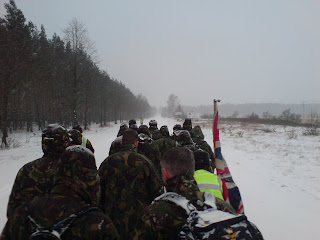
It reminded me of the context of the original picture of me in Poland. I was there as part of a "Staff Ride" - an week long activity to recreate a wartime event called The Long March, which happened in January 1945. In this case in 1945 the Prisoners from Stalag Luft III were forced to march from Sagan (in Poland) to Spremberg (in Germany). They did so in terrible weather - one of the worst winters on record - and with virtually no warm clothing or provisions, living on less than 100 Calories a day - taking upto three weeks to make the journey of 65 miles.
We followed the exact route that the Marchers had taken, albeit in modern clothing and with the support of a mobile catering unit. We did however do it in just three days, 21 miles on the first day, 20 on the second and 21 on the third day. We also did it in similar conditions given that we also did it at exactly the same time as one of the more infamous marches began.

Anyway, the first night that we arrived in Poland, we travelled to Sagan to the site of Stalag Luft III (also, as history buufs will know the site of the "Great Escape" in 1944) to spend the night in the camp. We were fortunate to camp on the site of the original camp - which is now, sadly, ruined and overgrown by the trees of the forest there. To get us in the mood for the whole endeavour (such as we needed!) it was decided that we should watch the classic film there.
Yeah, we actually watched the film of the Great Escape, where it actually happened! But even in the visitor centre where we were watching it, it was very cold. So to warm ourselves up we were given - by the locals some vodka.
Which was perhaps the roughest, nastiest vodka I have ever tasted. And of course, as is the fashion over in Poland, it was drunk neat...and so it was even rougher!

Vodka became a bit of a theme to the trip to be honest. With the locals where ever we stopped being the friendliest bunch ever - almost competing to out do he hospitality of the last! This was topped by the local Womens Institute of Lipna Luszcyka who put on a choral evening of folk music. Which included a very bizarre version of Viva Espania to an accordian!
The trip and the march we undertook was one of the hardest things I have ever done. It was physically and mentally demanding. At the end of the first day, marching through deepening snow which had been blowing into our faces all the way, over cobbles for 21 miles I was almost broken. About a mile from our destination I developed cramp in my thigh muscles and a sever sense of humour failure.
But I went on. There was nothing I could do other than go on. I was there to recreate something that people had done in far more and difficult circumstances to me and I was not going to be beaten. I was doing something that previous members of the Royal Air Force had done - and something that is not widely known about. I wanted to honour those who had done it by doing it myself.

And I think this is part of another reason why I enjoy being in the RAF.
It's being part of something. Part of something that has history and tradition. That is bigger than we are individually. The RAF is made up from little bits of greatness carried out by normal people. Ordinary men and women doing extra-ordinary things.
I did this March in 2007. I was 38. And it was here that I learnt that we need to belong to things. And that when things are really tough and we are in pain - we still need to keep going and keep working. Oh and that vodka is a lot stronger and rougher in Poland.

We followed the exact route that the Marchers had taken, albeit in modern clothing and with the support of a mobile catering unit. We did however do it in just three days, 21 miles on the first day, 20 on the second and 21 on the third day. We also did it in similar conditions given that we also did it at exactly the same time as one of the more infamous marches began.

Yeah, we actually watched the film of the Great Escape, where it actually happened! But even in the visitor centre where we were watching it, it was very cold. So to warm ourselves up we were given - by the locals some vodka.
Which was perhaps the roughest, nastiest vodka I have ever tasted. And of course, as is the fashion over in Poland, it was drunk neat...and so it was even rougher!

The trip and the march we undertook was one of the hardest things I have ever done. It was physically and mentally demanding. At the end of the first day, marching through deepening snow which had been blowing into our faces all the way, over cobbles for 21 miles I was almost broken. About a mile from our destination I developed cramp in my thigh muscles and a sever sense of humour failure.
But I went on. There was nothing I could do other than go on. I was there to recreate something that people had done in far more and difficult circumstances to me and I was not going to be beaten. I was doing something that previous members of the Royal Air Force had done - and something that is not widely known about. I wanted to honour those who had done it by doing it myself.

It's being part of something. Part of something that has history and tradition. That is bigger than we are individually. The RAF is made up from little bits of greatness carried out by normal people. Ordinary men and women doing extra-ordinary things.
I did this March in 2007. I was 38. And it was here that I learnt that we need to belong to things. And that when things are really tough and we are in pain - we still need to keep going and keep working. Oh and that vodka is a lot stronger and rougher in Poland.
Sunday, 10 January 2010
30 Million Quid and no CD player...
I got a new car this weekend. It's not Brand new, but, well it's newer than the 9 year old Golf I had that was stuttering on its last legs. Or wheels. Whatever.
The old one had a cassette player. Yeah! How 1990's, and the change between the old car and the new one (a CD PLAYER - WOW!) got me to thinking.
In the 90's I was working on 29(F)Sqn when it was flying Tonado F-3's. The Navigator would have to load the mission data for the flight using a data tape. On a standard C-90 cassette.
Yeah. A £30million aircraft. With a tape deck in it. It also served as a cockpit voice recorder (CVR) and also as a standard cassette deck which allowed for the aircrew to have something to listen to. (Phil Collins was always popular.)
The tape was loaded by pulling up a lever and then pulling the cassette unit upwards. It then moved through about 75 degrees so the tape could be fitted into the machine and the the unit was replaced back into the cockpit "dashboard".
OK, this is fairly boring stuff and I know it, but it's quite inportant in building upto the following short story.
One day I was seeing in a jet and after the engines had been shut down the ladder for the aircrew was pushed up to the side. The cockpit canopy raised and the aircrew unstrapped themselves from their ejection seats.
The Navigator looked a bit sheepish, and glanced at the Pilot who looked at me and laughed at him.
The Nav paced slowly down the steps with something behind his back as he approached me. "Errrr..." he started.
He produced the deck of the Cockpit Voice Recorder...which he had pulled right out of the dash of the jet!
"This came off in my hand. Errr...I'm sorry...I think I broke it...!"
The old one had a cassette player. Yeah! How 1990's, and the change between the old car and the new one (a CD PLAYER - WOW!) got me to thinking.
In the 90's I was working on 29(F)Sqn when it was flying Tonado F-3's. The Navigator would have to load the mission data for the flight using a data tape. On a standard C-90 cassette.
Yeah. A £30million aircraft. With a tape deck in it. It also served as a cockpit voice recorder (CVR) and also as a standard cassette deck which allowed for the aircrew to have something to listen to. (Phil Collins was always popular.)
The tape was loaded by pulling up a lever and then pulling the cassette unit upwards. It then moved through about 75 degrees so the tape could be fitted into the machine and the the unit was replaced back into the cockpit "dashboard".
OK, this is fairly boring stuff and I know it, but it's quite inportant in building upto the following short story.
One day I was seeing in a jet and after the engines had been shut down the ladder for the aircrew was pushed up to the side. The cockpit canopy raised and the aircrew unstrapped themselves from their ejection seats.
The Navigator looked a bit sheepish, and glanced at the Pilot who looked at me and laughed at him.
The Nav paced slowly down the steps with something behind his back as he approached me. "Errrr..." he started.
He produced the deck of the Cockpit Voice Recorder...which he had pulled right out of the dash of the jet!
"This came off in my hand. Errr...I'm sorry...I think I broke it...!"
Friday, 8 January 2010
The Second @RAFairman Competition Winner...

Rob Sharp, who's picture (from Twitter) can be seen here.
He wins the "Definitive Edition" Two disc set DVD of the 1969 epic film, "The Battle of Britain".
Congratulations Rob. If you don't follow him on Twitter - you should!
(NB - the prize was drawn by my girlfriend at random (from her Queen Alexandra's Royal Army Nursing Corps beret!)
I understand that Rob is still at college, but has passed his Officer and Airmans Selection Course for entry into the Royal Air Force, and he intends to go on to be an Communications/Informations Systems Officer.
Good luck for the future, Rob! And congratulations on winning the competition.
Wednesday, 6 January 2010
It Gets My Goat...
Just a quick whinge.
In the difficult weather that has hit the UK over the last 24-48 hours a lot has been made by some parts of the media (particularly in the south) about The Army assisting people trapped in cars out on the snowy and icy roads.
And this gets my goat.
You see, the same was said about the fireman's strike coverage a couple of years ago. The ARMY were replacing the firemen.
And Foot and Mouth...Remember that? Ohhhh yes, The ARMY were assisting with the culls and disposal of the animals bodies.
What about the other services? What about the Royal Air Force. What about Royal Navy personnel who have ALSO been involved?
I know for a fact that right now, RAF drivers are out in Landrovers with snowploughs fitted to the front. Despite the local news report on BBC Oxford saying "The Army has Chinooks on standby and have troops out rescuing people."
This shouldn't really annoy me - after all as long as people are getting the help they need then all for the good. But there is a point to my rant, isn't there?
Yeah, I think there is.
Just because the people out "Assisting the Local Community" are dressed in combat clothing (so called CS95) it doesn't mean that they are the Army.
After Op Fresco - the support during the Fireman's strike - the top brass in the RAF realised there was a PR gap. That in fact, a large proportion of those acting as temporary firefighters, were RAF. It was just that they hadn't been recognised as such because they were wearing CS95.
So to counter this, the brass came out with the idea that our CS95 have a couple of patches on them - and the best being "ROYAL AIR FORCE" in big letters on a patch sewn above the right-hand pocket of the shirts/jackets.
The thing is, the RAF, and to a certain extent the RN, are missing a trick. The Army is very good at telling the people of the UK about what they are doing - and have the added advantage of clothes to help! You see someone in greens - he's an "Army man".
This may sound a bit like sour grapes, but there is a serious side to it. And it's one the RAF and RN needs to grasp quickly.
Yes, the Army deserves recognition for what it does - both in the UK as well as in Afghanistan. Rightly so. The Army alone makes up just about half the strength of the UK Armed Forces. They are often the ones doing much of the actual the fighting (although the RAF Regiment and The Royal Marines, part of the Royal Navy would have something to say about this, as well as the aircrews of both of the other Services!
But if we don't tell the world about what we, in the Royal Air Force do, how we do it, and how important it is, then we risk losing some public awareness and consequently some public support.
And if we lose that, then we face the risk that the RAF, and it's hardworking personnel, will not get the credit that those helping the British public in the UK, and fighing in Afghan, so richly deserve.
In the difficult weather that has hit the UK over the last 24-48 hours a lot has been made by some parts of the media (particularly in the south) about The Army assisting people trapped in cars out on the snowy and icy roads.
And this gets my goat.
You see, the same was said about the fireman's strike coverage a couple of years ago. The ARMY were replacing the firemen.
And Foot and Mouth...Remember that? Ohhhh yes, The ARMY were assisting with the culls and disposal of the animals bodies.
What about the other services? What about the Royal Air Force. What about Royal Navy personnel who have ALSO been involved?
I know for a fact that right now, RAF drivers are out in Landrovers with snowploughs fitted to the front. Despite the local news report on BBC Oxford saying "The Army has Chinooks on standby and have troops out rescuing people."
This shouldn't really annoy me - after all as long as people are getting the help they need then all for the good. But there is a point to my rant, isn't there?
Yeah, I think there is.
Just because the people out "Assisting the Local Community" are dressed in combat clothing (so called CS95) it doesn't mean that they are the Army.
After Op Fresco - the support during the Fireman's strike - the top brass in the RAF realised there was a PR gap. That in fact, a large proportion of those acting as temporary firefighters, were RAF. It was just that they hadn't been recognised as such because they were wearing CS95.
So to counter this, the brass came out with the idea that our CS95 have a couple of patches on them - and the best being "ROYAL AIR FORCE" in big letters on a patch sewn above the right-hand pocket of the shirts/jackets.
The thing is, the RAF, and to a certain extent the RN, are missing a trick. The Army is very good at telling the people of the UK about what they are doing - and have the added advantage of clothes to help! You see someone in greens - he's an "Army man".
This may sound a bit like sour grapes, but there is a serious side to it. And it's one the RAF and RN needs to grasp quickly.
Yes, the Army deserves recognition for what it does - both in the UK as well as in Afghanistan. Rightly so. The Army alone makes up just about half the strength of the UK Armed Forces. They are often the ones doing much of the actual the fighting (although the RAF Regiment and The Royal Marines, part of the Royal Navy would have something to say about this, as well as the aircrews of both of the other Services!
But if we don't tell the world about what we, in the Royal Air Force do, how we do it, and how important it is, then we risk losing some public awareness and consequently some public support.
And if we lose that, then we face the risk that the RAF, and it's hardworking personnel, will not get the credit that those helping the British public in the UK, and fighing in Afghan, so richly deserve.
The SECOND @RAFairman competition...
As my Twitter followers will know I have been doing a clear out of my cupboards in my room in the Mess. (This is because I am going to be moving out of the Mess in the near future. Don't worry, I'm not posted or going out of area, just moving where I'm going to be living here at Benson!)

You need to include the title "@RAFairman Competiton" in the subject line of the email, and your full name in the main body of the message, along with the answer.
As part of this I have been doing a couple of little give-aways over on Twitter. But the next thing is a bit too...good for a quick give-away.
Anyway. I recently got a copy of the classic 1969 film "The Battle of Britain" on Blu-ray.
This means that my old copy of the film, on DVD, is surplus to my requirements now.
So, the next prize in the @RAFairman competition is going to be my copy of the Region 2 "Definitive Edition" of The Battle of Britain, on DVD.

The competition will run until Noon, on Friday 12 Jan 2010.
To enter you need to email me at RAFairman@live.co.uk (with "@RAFairman Competition" in the subject line) and in the body of the email, the answer to the following question:
To enter you need to email me at RAFairman@live.co.uk (with "@RAFairman Competition" in the subject line) and in the body of the email, the answer to the following question:
"Who was the Head of Number 11 Group, RAF, (the group that faced the brunt of the Luftwaffe attacks) during the Battle of Britain?"
(If you don't know, there is a great mini-site with loads of information over at the RAF Official Website - here)
Competition Rules!:
Be quick with your answers as the competition closes at 12 noon, Friday 8th Jan 2010. Emails received AFTER this time will not be entered into the draw.
The winner will be pulled at random from an RAF Beret on Friday evening. The Winners name will be posted on this blog and on Twitter shortly after.
Only one entry per email account is allowed. No correspondance will be entered into.
If you are lucky enough to be under 18 then you must have your parent/guardians permission to enter.
The Winner will win the a single copy of the Region 2 DVD of "the Battle of Britain".
The winner will also be notified by email as a reply to the competition entry email. No other accounts will be used.
Sorry, entry is limited to UK (and BFPO) residents only.
GOOD LUCK!
Tuesday, 5 January 2010
The Worst Duty I Have Ever Done...
Following on from the last post (and sorry for two in one day!), but I just got a tweet from Gaviscon79 on Twitter asking "What's the worst duty you've had to carry out?"
That's an easy one.
In my last job I ran a two-three day exercise for the trainees who were just about to leave their training and RAF Cosford and go into the wider RAF. It ran every Monday - Wednesday - in the field, living in an "austire" environment (very basic conditions).
And Last January (2008) it was very cold.
We'd need to arrive at the training area a good hour before the trainees to set up, and when we did we arrived to a scene that Shackleton, when he was stuck on the ice in the Antarctic, would have shiverred at.
It was a very thick frost. VERY thick. It had been down to -10 in the night before. Jolly cold. Particularly for the edge of rural Shropshire!
As I said the facilities were very basic - just a standpipe for water, and three chemical toilets for...well you know what chemical toilets are for!
And they were frozen up. Solid.
The standpipe was completely frozen...but worse were the chemical toilets.
They were frozen up too. Just imagine. Frozen chemical toilets...
And that (in the words of Forrest Gump) is ALL I have to say on that.
Have a nice warm day - where ever you are!
That's an easy one.
In my last job I ran a two-three day exercise for the trainees who were just about to leave their training and RAF Cosford and go into the wider RAF. It ran every Monday - Wednesday - in the field, living in an "austire" environment (very basic conditions).
And Last January (2008) it was very cold.
We'd need to arrive at the training area a good hour before the trainees to set up, and when we did we arrived to a scene that Shackleton, when he was stuck on the ice in the Antarctic, would have shiverred at.
It was a very thick frost. VERY thick. It had been down to -10 in the night before. Jolly cold. Particularly for the edge of rural Shropshire!
As I said the facilities were very basic - just a standpipe for water, and three chemical toilets for...well you know what chemical toilets are for!
And they were frozen up. Solid.
The standpipe was completely frozen...but worse were the chemical toilets.
They were frozen up too. Just imagine. Frozen chemical toilets...
And that (in the words of Forrest Gump) is ALL I have to say on that.
Have a nice warm day - where ever you are!
You think it's cold...
It's cold out there.
Really cold.
With more snow and ice on the way.
But as you spend 15 minutes de-frosting the car, or trudging along through icy and snowy streets to get to work - or even better to get HOME at the end of the day...spare a thought for those in the Services who are on Guard Duty right now.
A normal Guard Duty consists of 7 days of 12 hour shifts - either days or nights (6am-6pm/6pm-6am) and is basically standing on a gate checking passes. There'd normally be two people - one pass checker (unarmed) and one "covering guard" (armed) on each gate, where you greet all visitors to the station and make sure they have the correct identification documents and a correct reason to get onto the station. If you are really lucky, you might get to go out on a patrol of the station fenceline - two people again, basically going for a stroll to put a presence out on the ground.
The basic reason for a guard duty is to deter terrorists. It's the idea that is a station has effective security then the terrorists won't try to attack a particular base and will look for a less well defended target instead.
Now you are not out there in the cold for 12 hours, they are normally 2 hours on, 2 hours off...but as you wait for 15 minutes for the bus to turn up and remember how cold you got - imagine standing still for 2 hours outside. It's dull. It's boring. It's not doing the job we exactly joined the RAF to do - we joined to be Engineers and Suppliers and so on..But it's very important and means that the rest of us on station - particularly those who live on station can rest a little easier knowing the station is guarded.
But it's made a whole lot more difficult by the weather. And weather like we are having at the moment is probably the worst. There is nothing worse than being cold.
It's not fun, but it's something we have to do. And I know I have one coming up soon, but thankfully "rank has it's priviliges" and I'll be supervising the guards...and I'll be inside for a lot of the time!
Really cold.
With more snow and ice on the way.
But as you spend 15 minutes de-frosting the car, or trudging along through icy and snowy streets to get to work - or even better to get HOME at the end of the day...spare a thought for those in the Services who are on Guard Duty right now.
A normal Guard Duty consists of 7 days of 12 hour shifts - either days or nights (6am-6pm/6pm-6am) and is basically standing on a gate checking passes. There'd normally be two people - one pass checker (unarmed) and one "covering guard" (armed) on each gate, where you greet all visitors to the station and make sure they have the correct identification documents and a correct reason to get onto the station. If you are really lucky, you might get to go out on a patrol of the station fenceline - two people again, basically going for a stroll to put a presence out on the ground.
The basic reason for a guard duty is to deter terrorists. It's the idea that is a station has effective security then the terrorists won't try to attack a particular base and will look for a less well defended target instead.
Now you are not out there in the cold for 12 hours, they are normally 2 hours on, 2 hours off...but as you wait for 15 minutes for the bus to turn up and remember how cold you got - imagine standing still for 2 hours outside. It's dull. It's boring. It's not doing the job we exactly joined the RAF to do - we joined to be Engineers and Suppliers and so on..But it's very important and means that the rest of us on station - particularly those who live on station can rest a little easier knowing the station is guarded.
But it's made a whole lot more difficult by the weather. And weather like we are having at the moment is probably the worst. There is nothing worse than being cold.
It's not fun, but it's something we have to do. And I know I have one coming up soon, but thankfully "rank has it's priviliges" and I'll be supervising the guards...and I'll be inside for a lot of the time!
Monday, 4 January 2010
To kill for...
Last night I commented on Twitter that I really dislike the "Go Compare" insurance adverts with a comment that I could actually kill the person who dreamt it up - and I am not normally like that."
Now this was a silly thing to say - of course I wouldn't do such a thing - it was just a joke and the advertising exec who came up with the campaign has won, because even though it's a terrible and annoying advert, who's name is the first on your lips when thinking of car insurance? Yeah...Go Compare...
But I digress.
Of the several comments that Tweet got a couple were along the lines of "you are in the armed forces - I thought that you were trained to kill?"
Hmmmmmm. Indeed.
This IS a good point. I am trained to kill.
Really.
Each year we all have to go and undertake our Common Core Skills training - how to handle a rifle and so on, and I have done courses in the past about military skills in the field and so forth.
And every year or so we will all do a Guard Duty where we will be armed with a rifle and will go and stand on the gate to guard the station. (That said now I am a "grown up" I will be supervising the guards, and not actually standing out in the cold - but I'd be there in spirit!) As part of the training, you would undergo qualifying shoots to ensure you are prepared to handle a rifle safely.
But normally you never really think you are going to have to actually use it.
And I think that is the big difference between myself (and a LOT of other RAF personnel) and say, the Army.
They are soldiers first and foremost. We, are tradesmen first and soldiers second. It is the essence of what they are there to do. For us, it's slightly different.
We are Engineers, Suppliers, Admin-ers...who are also trained to fight. But in my 22+ years I have never fired a shot in anger - even though I've been to more than one war zone, and been in at least one shooting war.
It took me a while to realise though, that I might one day have to fight. When I joined the RAF back in 1987 we had the Russians as our enemy. They were never really going to come and fight us, as the stakes were too high - Nuclear war and all that. But all of a sudden I found myself in Saudi in 1991. And I was sending aircraft off to fight for the liberation of Kuwait. Now I wasn't directly involved in killing people. But the aircraft I was servicing and putting into the air could have been. The Radars I fixed were designed to be Air Interception Radars. Their job is to find other aircraft and shoot them down.
Now I could sort of distance myself from the fact that people could die from what I did by saying that I had only a small part in it - and an indirect one at that...but then isn't that the same excuse that the people living near to Auswitz used? They knew what was going on, but it wasn't directly their fault?
Then I was on guard and I realised I was holding a rifle and could be called upon to use it. If someone came to attack the camp then I might have to fire that weapon.
And I realised.
That's my job. The guard duty is a metaphor. It's protecting the nation and what the nation stands for in miniture.
I am happy that if I had to - if a bad person was attempting to attack, injure or kill people I know (particularly my family) then I would use anything I could to protect them. If I had to I would use a rifle and shoot - to kill - that bad person.
And there are a lot of bad people in the world. Bad people who want to do bad things.
And my family - and my families family, and my families families family - deserves that right to protection. Everyone who lives in the UK regardless of race, creed or colour deserves that right to protection from the state.
I have fought against bad people. People who have done bad things to people. People who want others to suffer and be subjugated. And these bad people need to be stopped. If my country says that there are bad people somewhere doing bad things then I will do my best to try and stop them.
I want our country to be a force for good - and that is part of the job of the British Armed Forces - to be a force for good in the world.
And that is my job. I will do it. And that includes taking someone elses life if I have to.
Now this was a silly thing to say - of course I wouldn't do such a thing - it was just a joke and the advertising exec who came up with the campaign has won, because even though it's a terrible and annoying advert, who's name is the first on your lips when thinking of car insurance? Yeah...Go Compare...
But I digress.
Of the several comments that Tweet got a couple were along the lines of "you are in the armed forces - I thought that you were trained to kill?"
Hmmmmmm. Indeed.
This IS a good point. I am trained to kill.
Really.
Each year we all have to go and undertake our Common Core Skills training - how to handle a rifle and so on, and I have done courses in the past about military skills in the field and so forth.
And every year or so we will all do a Guard Duty where we will be armed with a rifle and will go and stand on the gate to guard the station. (That said now I am a "grown up" I will be supervising the guards, and not actually standing out in the cold - but I'd be there in spirit!) As part of the training, you would undergo qualifying shoots to ensure you are prepared to handle a rifle safely.
But normally you never really think you are going to have to actually use it.
And I think that is the big difference between myself (and a LOT of other RAF personnel) and say, the Army.
They are soldiers first and foremost. We, are tradesmen first and soldiers second. It is the essence of what they are there to do. For us, it's slightly different.
We are Engineers, Suppliers, Admin-ers...who are also trained to fight. But in my 22+ years I have never fired a shot in anger - even though I've been to more than one war zone, and been in at least one shooting war.
It took me a while to realise though, that I might one day have to fight. When I joined the RAF back in 1987 we had the Russians as our enemy. They were never really going to come and fight us, as the stakes were too high - Nuclear war and all that. But all of a sudden I found myself in Saudi in 1991. And I was sending aircraft off to fight for the liberation of Kuwait. Now I wasn't directly involved in killing people. But the aircraft I was servicing and putting into the air could have been. The Radars I fixed were designed to be Air Interception Radars. Their job is to find other aircraft and shoot them down.
Now I could sort of distance myself from the fact that people could die from what I did by saying that I had only a small part in it - and an indirect one at that...but then isn't that the same excuse that the people living near to Auswitz used? They knew what was going on, but it wasn't directly their fault?
Then I was on guard and I realised I was holding a rifle and could be called upon to use it. If someone came to attack the camp then I might have to fire that weapon.
And I realised.
That's my job. The guard duty is a metaphor. It's protecting the nation and what the nation stands for in miniture.
I am happy that if I had to - if a bad person was attempting to attack, injure or kill people I know (particularly my family) then I would use anything I could to protect them. If I had to I would use a rifle and shoot - to kill - that bad person.
And there are a lot of bad people in the world. Bad people who want to do bad things.
And my family - and my families family, and my families families family - deserves that right to protection. Everyone who lives in the UK regardless of race, creed or colour deserves that right to protection from the state.
I have fought against bad people. People who have done bad things to people. People who want others to suffer and be subjugated. And these bad people need to be stopped. If my country says that there are bad people somewhere doing bad things then I will do my best to try and stop them.
I want our country to be a force for good - and that is part of the job of the British Armed Forces - to be a force for good in the world.
And that is my job. I will do it. And that includes taking someone elses life if I have to.
Tuesday, 29 December 2009
Bueno Estente...!
Earlier this evening I was flicking through the Sky Channels and came across an episode of "The Fast Show" and in particular the sketch was the famous Chanel9 News and weather. If you've not seen it, the weather girl on there gives the forcast in a mad language but essentially says that everywhere is going to be "Scorchio".
This reminded me of a trip we once made across the Atlantic with some Tornado F3's. We were working on the Towed Radar Decoy that was fitted to the aircraft which was to undergo a trial in the vast deserts of Nevada. (Unfortunately this meant that we had to stay in Vegas...but into each life some rain must fall. But I digress.)
The Tornados couldn't make it all the way across the Atlantic and so we had to stage through the Lajes in the Azores. The engineers put the aircraft to bed and we raced to the hotel where we were to spend the night.
Here we arrived and were allocated rooms all along one corridor and we ruched to the rooms for a shower and to get changed so we could go out for a beer and some food. As is the RAF we, all the doors of the rooms were left open as we set about checking out the facilities. Each room had a TV - unfortunately with only one channel. Almost as one people turned the TV on and of course the local Azores weather forecast was on - in the local language of Portugese, presented by a young lady.
And as if as one...all that could be heard shouted from each room was "Scorchio!".
That night turned into a very, very long night...so long in fact that I didn't get back to my room until about 5:30am - having been to a very nice club on the beach, and made sand angels with a couple of locals who were quite friendly. The only thing about getting back at 5:30 was the fact that we had a call for the aircraft at 6:30. So a shower and a change and I was in the lobby of the hotel with my bag - and the bed unslept in.
The bonus was that we were flying across the Atlantic in a VC10 tanker which only had sbout 30 seats and the rest of the cabin was empty...enough space for me (and my room mate Mike - who'd been out with me all evening) to stretch out in and get a lot of sleep. I don't remember anything of the rest of the journey to Bangor in Maine, where our next stop over was.
And that night involved a newly opened bar. A baseball hat tucked into my back pocket and a very grumpy couple of bouncers who seemed to think it was a gun. But that is another story...
This reminded me of a trip we once made across the Atlantic with some Tornado F3's. We were working on the Towed Radar Decoy that was fitted to the aircraft which was to undergo a trial in the vast deserts of Nevada. (Unfortunately this meant that we had to stay in Vegas...but into each life some rain must fall. But I digress.)
The Tornados couldn't make it all the way across the Atlantic and so we had to stage through the Lajes in the Azores. The engineers put the aircraft to bed and we raced to the hotel where we were to spend the night.
Here we arrived and were allocated rooms all along one corridor and we ruched to the rooms for a shower and to get changed so we could go out for a beer and some food. As is the RAF we, all the doors of the rooms were left open as we set about checking out the facilities. Each room had a TV - unfortunately with only one channel. Almost as one people turned the TV on and of course the local Azores weather forecast was on - in the local language of Portugese, presented by a young lady.
And as if as one...all that could be heard shouted from each room was "Scorchio!".
That night turned into a very, very long night...so long in fact that I didn't get back to my room until about 5:30am - having been to a very nice club on the beach, and made sand angels with a couple of locals who were quite friendly. The only thing about getting back at 5:30 was the fact that we had a call for the aircraft at 6:30. So a shower and a change and I was in the lobby of the hotel with my bag - and the bed unslept in.
The bonus was that we were flying across the Atlantic in a VC10 tanker which only had sbout 30 seats and the rest of the cabin was empty...enough space for me (and my room mate Mike - who'd been out with me all evening) to stretch out in and get a lot of sleep. I don't remember anything of the rest of the journey to Bangor in Maine, where our next stop over was.
And that night involved a newly opened bar. A baseball hat tucked into my back pocket and a very grumpy couple of bouncers who seemed to think it was a gun. But that is another story...
Thursday, 24 December 2009
A Seasonal Wish...
As it is Christmas Eve, I would like to take the opportunity to thank everyone for spending time reading this blog and to those who have helped to contribute to the content by asking questions or engaging in great conversations over on Twitter.
I'd like to wish everyone a very Merry Christmas and a Happy and Prosperous New Year.
Finally, as we all tuck into our festive food and drink, I'd like to ask you all to spend just a moment thinking about all members of the British Army, the Royal Air Force and the Royal Navy who are not able to spend their Chrstmas at home with their loved ones, and particularly to think about the 107 men and women who died this year and will never spend another Christmas with their loved ones.
These 107 are:
Sjt Christopher Reed
Marine Travis Mackin
Cpt Tom Sawyer
Cpl Danny Winter
Cpl Richard Robinson
Cpl Daniel Neild
Marine Darren Smith
L/Cpl Stephen Kingscott
Cpl Tom Gaden
Rifleman Jamie Gunn
L/Cpl Paul Upton
Marine Michael Laski
L/Cpl Christopher Harkett
Cpl Greame Stiff
Cpl Dean John
L/Sgt Tobie Fasfous
Cpl Sean Binnie
Rifleman Adrian Sheldon
Sgt Ben Ross
Cpl Kumar Pun
Lt Mark Evison
Marine Jason Mackie
Fusilier Petero Suesue
Sapper Jordon Rossi
L/Cpl Kieron Hill
L/Cpl Robert Richards
L/Cpl Nigel Moffet
Cpl Stephen Bolger
Rifleman Cyrus Thatcher
Pte Robert McLaren
Lt Paul Mervis
Major Sean Birchall
Trooper Joshua Hammond
Lt Col Robert THorneloe
L/Cpl David Dennis
Pte Robert Laws
L/Cpl Dane Elson
Capt Ben Babbington-Browne
Trooper Christopher Whiteside
Rifleman Daniel Hume
Pte John Brackpool
Cpl Jonathan Horne
Rifleman Daniel Simpson
Rifleman Joseph Murphy
Rifleman William Aldridge
Rifleman James Backhouse
Cpl Lee Scott
Rifleman Aminiasi Toge
Cpl Joseph Etchells
Capt Daniel Sheperd
Guardsman Christopher King
Bombardier Craig Hopson
WO2 Sean Upton
Trooper Phillip Lawrence
Craftsman Anthony Lombardi
Pte Kyle Adams
Cpl Kevin Mulligan
Pte Jason Williams
Capt Mark Hale
Rifleman Daniel Wild
Lance Bombardier Matthew Hatton
Pte Richard Hunt
Sgt Simon Valentine
Fusilier Louis Carter
L/Cpl James Fullarton
Fusilier Simon Annis
Sjt Paul McAleese
Pte Johnathon Young
Fusiler Shaun Bush
Sgt Lee Houltram
Pte Kevin Elliot
Sgt Stuart Millar
L/Cpl Richard Brandon
Pte Gavin Elliott
Cpl John Harrison
Kingsman Jason Dunn-Bridgeman
A/Sjt Michael Lockett
Pte James Prosser
Senior Aircraftsman Marcin Wojtak
Guardsman Jamie Janes
L/Cpl James Hill
Cpl James Oakland
Cpl Thomas Mason
Staff Sgt Olaf Schmid
Sgt Matthew Telford
A/Cpl Steven Boote
Cpl Nicholas Webster-Smith
Guardsman Jimmy Major
WO1 Darren Chant
Sjt Phillip Scott
Rifleman Phillip Allen
Rifleman Samuel Bassett
Cpl Loren Marlton-Thomas
Rifleman Andrew Fentiman
Sgt Robert Loughran-Dickson
A/Sgt John Amer
Rifleman James Brown
L/Cpl David Kirkness
Cpl Simon Hornby
L/Cpl Michael Pritchard
Unnamed from the Parachute Regiment
L/Cpl Christopher Roney
RIP
Merry Christmas.
I'd like to wish everyone a very Merry Christmas and a Happy and Prosperous New Year.
Finally, as we all tuck into our festive food and drink, I'd like to ask you all to spend just a moment thinking about all members of the British Army, the Royal Air Force and the Royal Navy who are not able to spend their Chrstmas at home with their loved ones, and particularly to think about the 107 men and women who died this year and will never spend another Christmas with their loved ones.
These 107 are:
Sjt Christopher Reed
Marine Travis Mackin
Cpt Tom Sawyer
Cpl Danny Winter
Cpl Richard Robinson
Cpl Daniel Neild
Marine Darren Smith
L/Cpl Stephen Kingscott
Cpl Tom Gaden
Rifleman Jamie Gunn
L/Cpl Paul Upton
Marine Michael Laski
L/Cpl Christopher Harkett
Cpl Greame Stiff
Cpl Dean John
L/Sgt Tobie Fasfous
Cpl Sean Binnie
Rifleman Adrian Sheldon
Sgt Ben Ross
Cpl Kumar Pun
Lt Mark Evison
Marine Jason Mackie
Fusilier Petero Suesue
Sapper Jordon Rossi
L/Cpl Kieron Hill
L/Cpl Robert Richards
L/Cpl Nigel Moffet
Cpl Stephen Bolger
Rifleman Cyrus Thatcher
Pte Robert McLaren
Lt Paul Mervis
Major Sean Birchall
Trooper Joshua Hammond
Lt Col Robert THorneloe
L/Cpl David Dennis
Pte Robert Laws
L/Cpl Dane Elson
Capt Ben Babbington-Browne
Trooper Christopher Whiteside
Rifleman Daniel Hume
Pte John Brackpool
Cpl Jonathan Horne
Rifleman Daniel Simpson
Rifleman Joseph Murphy
Rifleman William Aldridge
Rifleman James Backhouse
Cpl Lee Scott
Rifleman Aminiasi Toge
Cpl Joseph Etchells
Capt Daniel Sheperd
Guardsman Christopher King
Bombardier Craig Hopson
WO2 Sean Upton
Trooper Phillip Lawrence
Craftsman Anthony Lombardi
Pte Kyle Adams
Cpl Kevin Mulligan
Pte Jason Williams
Capt Mark Hale
Rifleman Daniel Wild
Lance Bombardier Matthew Hatton
Pte Richard Hunt
Sgt Simon Valentine
Fusilier Louis Carter
L/Cpl James Fullarton
Fusilier Simon Annis
Sjt Paul McAleese
Pte Johnathon Young
Fusiler Shaun Bush
Sgt Lee Houltram
Pte Kevin Elliot
Sgt Stuart Millar
L/Cpl Richard Brandon
Pte Gavin Elliott
Cpl John Harrison
Kingsman Jason Dunn-Bridgeman
A/Sjt Michael Lockett
Pte James Prosser
Senior Aircraftsman Marcin Wojtak
Guardsman Jamie Janes
L/Cpl James Hill
Cpl James Oakland
Cpl Thomas Mason
Staff Sgt Olaf Schmid
Sgt Matthew Telford
A/Cpl Steven Boote
Cpl Nicholas Webster-Smith
Guardsman Jimmy Major
WO1 Darren Chant
Sjt Phillip Scott
Rifleman Phillip Allen
Rifleman Samuel Bassett
Cpl Loren Marlton-Thomas
Rifleman Andrew Fentiman
Sgt Robert Loughran-Dickson
A/Sgt John Amer
Rifleman James Brown
L/Cpl David Kirkness
Cpl Simon Hornby
L/Cpl Michael Pritchard
Unnamed from the Parachute Regiment
L/Cpl Christopher Roney
RIP
Merry Christmas.
Tuesday, 22 December 2009
A Little Bit of History...
The footnote at the end of my last blog post about the history behind the blue uniform that we in the RAF wear led to a short Twitter conversation about a few bits of history and traditions we have.
One of those is why RAF bases are officially called Stations. For example Royal Air Force Station Benson.
Why are they called Stations and not Bases, or even Barracks?
The history - as far as I know it - behind this is this:
Lord Trenchard (the so called "Father of the RAF") spent his early years in the Army posted in India, where the military bases were often called Stations simply because they were alongside railway stations.
When he returned to the UK and set about the establishment of the Royal Air Force in 1918 he wanted to make the newly named RAF bases clearly different from the Army and Navy bases...and so he remembered his time in India and the Stations he had been posted to.
And so Royal Air Force Stations were established...
By they way, if you have any more questions then please ask away!
One of those is why RAF bases are officially called Stations. For example Royal Air Force Station Benson.
Why are they called Stations and not Bases, or even Barracks?
The history - as far as I know it - behind this is this:
Lord Trenchard (the so called "Father of the RAF") spent his early years in the Army posted in India, where the military bases were often called Stations simply because they were alongside railway stations.
When he returned to the UK and set about the establishment of the Royal Air Force in 1918 he wanted to make the newly named RAF bases clearly different from the Army and Navy bases...and so he remembered his time in India and the Stations he had been posted to.
And so Royal Air Force Stations were established...
By they way, if you have any more questions then please ask away!
What to Wear...?
This news story about the new uniform to be issued to British Armed Forces got me thinking today.
It got me thinking about the amount of clothing I have been issued over the years. In my years in the service I've been issued the following:
No 1 Dress Uniform.
No 2 Working Dress.
DPM CS95 Combats.
Desert DPM CS95 Combats.
Tropical DPM Combats.
Khaki Drill (KD) Uniform.
(Oh and I bought my own No 5 Mess Dress.)
Now that's a LOT of stuff.
And a lot of kit. At a lot of money for each set of clothes, because the No 2's is, if I recall correctly, three pairs of trousers, two jumpers, 5 shirts, two ties, two belts, one pair of shoes and several pairs of socks. Added to that, there is a General Purpose Jacket (GPJ) - like a Bomber jacket as well as a Gore-Tex raincoat.
The CS95 has a similar range of kit - a lot of stuff...which means I need a big locker to store it in.
Now I had a thought about the range of sizes that are needed. And the amount of kit that there needs to be for 42,000 members of the RAF. And the stroage space for it.
It all adds up to a lot of clothing - and a lot of money spent of just clothing the RAF.
For what?
Why do we need so many different items of clothing. Why do we need so many items of clothing?
What for? Those who work on aircraft also have a set of working dark blue shirts and sets of denim coveralls to protect their uniform. What's the point of all this kit?
Why not get rid of the No2 working blues? We don't need them. Everything we do can be done in Combats. We could save a huge amount from the defence budget by binning the blues, and just wearing the greens.
CS95 is more comfortable and hardwearing. It woud also remind some people that the RAF is a deployable fighting force. We would all be wearing the same - and to add a bit of spice we could differentiate between trades by having trade badges on our greens (a bit like the RAF Regiment do with their "mud-guards").
I see the need for the Blue No1's Dress Uniform. This could be our link to the past - out tradition and our heritage. But modern day operations mean that No2's are just an anchronism of the past and do little but waste our time and the taxpayers (and we are taxpayers too) money!
So I say for one last time. Let's get rid of the No2 Working Dress and have all members of the RAF wearing CS95 Greens or the new stuff when that comes in.
(Oh and by the way, do you know why we in the RAF wear the blue that we do? Well, the RAF was of course formed in 1918 from the amalgamation of the Royal Naval Air Service and the Royal Flying Corps. It needed a Uniform. There was a pre-made uniform available sitting in a warehouse. The Tsar of Russia had ordered a new set of clothing in Russian Blue for his armed forces, but of course the Tzar had been deposed in the Russian Revolution in 1917.
So it made sense to use this set of uniform that was sitting gathering dust for the new service that was the Royal Air Force.)
It got me thinking about the amount of clothing I have been issued over the years. In my years in the service I've been issued the following:
No 1 Dress Uniform.
No 2 Working Dress.
DPM CS95 Combats.
Desert DPM CS95 Combats.
Tropical DPM Combats.
Khaki Drill (KD) Uniform.
(Oh and I bought my own No 5 Mess Dress.)
Now that's a LOT of stuff.
And a lot of kit. At a lot of money for each set of clothes, because the No 2's is, if I recall correctly, three pairs of trousers, two jumpers, 5 shirts, two ties, two belts, one pair of shoes and several pairs of socks. Added to that, there is a General Purpose Jacket (GPJ) - like a Bomber jacket as well as a Gore-Tex raincoat.
The CS95 has a similar range of kit - a lot of stuff...which means I need a big locker to store it in.
Now I had a thought about the range of sizes that are needed. And the amount of kit that there needs to be for 42,000 members of the RAF. And the stroage space for it.
It all adds up to a lot of clothing - and a lot of money spent of just clothing the RAF.
For what?
Why do we need so many different items of clothing. Why do we need so many items of clothing?
What for? Those who work on aircraft also have a set of working dark blue shirts and sets of denim coveralls to protect their uniform. What's the point of all this kit?
Why not get rid of the No2 working blues? We don't need them. Everything we do can be done in Combats. We could save a huge amount from the defence budget by binning the blues, and just wearing the greens.
CS95 is more comfortable and hardwearing. It woud also remind some people that the RAF is a deployable fighting force. We would all be wearing the same - and to add a bit of spice we could differentiate between trades by having trade badges on our greens (a bit like the RAF Regiment do with their "mud-guards").
I see the need for the Blue No1's Dress Uniform. This could be our link to the past - out tradition and our heritage. But modern day operations mean that No2's are just an anchronism of the past and do little but waste our time and the taxpayers (and we are taxpayers too) money!
So I say for one last time. Let's get rid of the No2 Working Dress and have all members of the RAF wearing CS95 Greens or the new stuff when that comes in.
(Oh and by the way, do you know why we in the RAF wear the blue that we do? Well, the RAF was of course formed in 1918 from the amalgamation of the Royal Naval Air Service and the Royal Flying Corps. It needed a Uniform. There was a pre-made uniform available sitting in a warehouse. The Tsar of Russia had ordered a new set of clothing in Russian Blue for his armed forces, but of course the Tzar had been deposed in the Russian Revolution in 1917.
So it made sense to use this set of uniform that was sitting gathering dust for the new service that was the Royal Air Force.)
Sunday, 20 December 2009
Every Day is a Learning Day...
In my last job I was an instructor at a training camp. It was the very best job, as the post gave me freedom to do pretty much what I wanted. Well I say that, but what we had to teach was strictly set down - but HOW to teach it was not, and my post was all about teaching trainees to be "better" airmen. The technical schools did their job at making them good technicians, but it was my job to get them to be good airmen; to expand their soft skills - teamwork, communication, common sense...
I did this through running a 3 day exercise at the end of their training course where as well as doing their primary role of working on aircraft or tele-communications equipment (or even as combat photographers!) they had to pretend to be deployed to a Forward Operating Base in a made up country in Africa.
This deployment was in reality to the far side of the airfield, but it was to a purpose built campsite that was "austere". This meant that there were no home comforts. Just tents to sleep in, a mess tent for cooking rations for food and a command bunker made from the same materials that they will find when they go into theatre - Hesco-Bastion. At the two entrances to the camp there were also Hesco guard posts that provided protection against “mortars” and such like. Here mobile phones were banned and they stayed on site for the three days working long days (from 6am-midnight) rotating between providing security for the site (guard duties and patrols) and working on the aircraft.
Anyway, to make the deployment more realistic, we as instructors would throw in scenarios for the trainees to respond to. These would be, at times, quite realistic...from vehicle patrols that would drive over a "Improvised Explosive Device" (the now infamous "IED") to foot patrols to recover "pilots" who had ejected from crashed aircraft.
One that I came up with was an extended one that ran for a couple of hours and relied on one of the trainees to help me out. This was a "Proxy-bomber" scenario.
In this I would wait until the night and take a section out on a foot patrol, having primed the last man in the team to go missing as we patrolled through a particularly dark area. The section would invariably not notice that he was missing until we returned to the safety of the base...
(He himself was primed to make his own way to a nice safe portacabin - with the luxury of a real toilet and a proper heater. There he would find a set of combat body armour (CBA) with the kevlar removed and stuffed with rolls of paper. These inside the CBA would look like sticks of explosive. Wires and an "aerial" would complete the gear - to make it look like he was wearing a "suicide bomber" jacket.
Now this is serious stuff. One of the things that has happened in the past Northern Ireland and Vietnam and a few other places) is the idea of a proxy bomber. The "enemy" would capture someone and strap a bomb to them and then send them back to the place that they want blowing up. This way maximum damage for minimal losses.
So. Our stooge, Paul, straps himself into the CBA and, at the pre-determined time, leaves the safety and warmth of the portacabin and walks across to the main gate of the FOB, where, by matter of chance is one of his course-mates.
As he gets close to the gate, he then starts to shout and scream for help, as he had been told to in his briefing earlier. I told him that he must scream for help and tell the guards that he had been captured by the enemy, who had strapped this jacket to him and then told him it was a bomb. He then was released and told to "go home". The enemy were watching him and the bomb jacket was remote controlled and would explode it when they were ready. His task was to gain entry to the camp anyway he could – to push past the guards, anything, short of actual physical violence. However, should the guards be calm – he was to calm down, basically he was to the guards in the way they reacted to him. Finally, if he was told to go into the Hesco’s by the gate then he was to do so.
This is actually the best outcome for this situation. If the poor lad was wearing a bomb then the best thing for him is to be calmed down and brought onto the camp but placed in a location that will cause as little damage as possible if the bomb detonates. Whilst in this location he can then wait for Bomb-Disposal (or EOD) who will come to save him!
Back at the FOB…Our lad came wandering up to the gate shouting. The guard does exactly as he should do and issue a warning along the lines of stop or I fire. The lad stops and puts his hands up, but carries on shouting “Help” only this time he adds the name of the guard (who we’ll call “Jonesy”).
Jonesy asks his course mate what is going on and the lad replies exactly as he has been told. “I’ve got a bomb strapped to me! The bastards are watching and say they are gonna blow it!” (He must be commended for his acting.)
At this news Jonesy takes a step back. And pulls out his radio. But the other guard shouts at him not to transmit…IED’s can explode if a radio is used near to them. (Tick, very good, to that lad – he’s learnt something on his training!) Jonesy tells him to run to “get someone – anyone!” which he duly does…this leaves poor Jonesy on his own.
Paul starts to move forward again…”Come on mate, let me in…I don’t want to die!” But Jonesy stands firm. “Paul, mate stand still. Sit down there and be cool…” (Well done Jonesy; trying to calm the poor fella.)
Jonesy tries to talk to Paul and calm him, but as he does so, starts to panic a little and so Paul does as instructed and starts to do the same. Paul stands up and walks towards the gate…Jonesy steps back…and Paul gets up to the gate line. He goes to step into the camp and this sets Jonesy into a real panic.
Now Jonesy is “armed” with the standard issue L85A2 “SA80” assault rifle, with two magazines of 30 rounds of blank ammunition. As Paul steps forward one more time, Jonesy cocks the rifle and then as Paul takes one more step he takes aim and fires the rifle…AT HIS MATE PAUL.
Now I had been watching all this, without stepping in at any stage, but at this dramatic turn of events I had to.
Paul stood and looked at Jonesy. Then, rather comically, down at his chest, where he’d just been “shot”. Obviously there was nothing there and he was perfectly alright, but…but…it was what it meant.
I stepped forward. “Jonesy, put the rifle down and step back. What the hell…What did you just do…What the hell, man…SHIT YOU SHOT HIM!”
“I, I, I, didn’t know what to do…”
“So you thought you’d shoot me!” said Paul.
“I, I, I, er….shit. I…errrrr...”
“Right. Seriously Jones. Put the rifle down and go and sit down. You SHOT HIM!” I said. I honestly couldn’t believe what had happened. And to be honest I was a bit lost for what to do next.
I mean Jonesy had just “shot” hit mate. Someone who he had been with all the way through training, some 7 months. This was mad, crazy. How the hell do we…I…deal with this, and what it meant.
It meant that Jonesy and Paul’s trust had just been seriously attacked and diminished. It meant that Jonesy needed to think a bit more about what he might be faced with in the future. It meant that in 6 months time when Jonesy is deployed and on guard at a gate somewhere hot and dusty and scary…well how would he cope if this happened for real.
“Jonesy. You shot your mate. Can you imagine what the hell this would have meant if this was for real? Can you imagine the front page of the newspapers? ’Cos I tell you what, mate, something like this would make page one. Big time!”
“I want you to go and have a cuppa in the Mess Tent, and have a chill out and think about this event. Don’t worry about it, nothings going to happen over it – it’s why we have training, so we can make mistakes where the outcome doesn’t really matter. But you still need to have a good think about it.”
And I did too. It made me think about what our young lads have to go through. How would I have dealt with that scenario? What would I have done? How would I have coped with Paul shouting and screaming? Would I have been a calming influence? Or would I have panicked like Jones and done something mad, crazy?
When I was a young trainee of 18-19 the biggest thing that we were faced with were the big bad Russians who were going to come across and bomb us. But we knew that in reality they were never going to actually do that. We would never really have to go to war, and certainly would never be face to face with the enemy.
But these lads…they have to go out to Afghanistan or where-ever the hell we are sent to next, and are faced with seeing and doing things that I would never have imagined. And it made me a bit scared, but also a bit proud. What I was doing was helping them to be prepared for such things…in a way I had never been prepared for. Maybe because of this incident – Jonesy for certain – would be better aware of himself and of what he may have to do in the future so that he doesn’t make a mistake like for real, where it may actually cost someone their life.
After a good sit down and a bit of banter and a good cup of tea, Jonesy was ok. He had learnt a bit about himself and maybe matured ever so slightly. He certainly had learnt a few things that might help him in his future career. Paul forgave him for shooting him…saying that if the shoe was on the other foot then he had no idea how he would have coped.
And again it made me think. How would I have dealt with it in real life? But for the moment I am lucky and I don’t have to think about how I would do it for real.
And to be honest, I hope I don’t HAVE to think about it for real and never have to face it.
I did this through running a 3 day exercise at the end of their training course where as well as doing their primary role of working on aircraft or tele-communications equipment (or even as combat photographers!) they had to pretend to be deployed to a Forward Operating Base in a made up country in Africa.
This deployment was in reality to the far side of the airfield, but it was to a purpose built campsite that was "austere". This meant that there were no home comforts. Just tents to sleep in, a mess tent for cooking rations for food and a command bunker made from the same materials that they will find when they go into theatre - Hesco-Bastion. At the two entrances to the camp there were also Hesco guard posts that provided protection against “mortars” and such like. Here mobile phones were banned and they stayed on site for the three days working long days (from 6am-midnight) rotating between providing security for the site (guard duties and patrols) and working on the aircraft.
Anyway, to make the deployment more realistic, we as instructors would throw in scenarios for the trainees to respond to. These would be, at times, quite realistic...from vehicle patrols that would drive over a "Improvised Explosive Device" (the now infamous "IED") to foot patrols to recover "pilots" who had ejected from crashed aircraft.
One that I came up with was an extended one that ran for a couple of hours and relied on one of the trainees to help me out. This was a "Proxy-bomber" scenario.
In this I would wait until the night and take a section out on a foot patrol, having primed the last man in the team to go missing as we patrolled through a particularly dark area. The section would invariably not notice that he was missing until we returned to the safety of the base...
(He himself was primed to make his own way to a nice safe portacabin - with the luxury of a real toilet and a proper heater. There he would find a set of combat body armour (CBA) with the kevlar removed and stuffed with rolls of paper. These inside the CBA would look like sticks of explosive. Wires and an "aerial" would complete the gear - to make it look like he was wearing a "suicide bomber" jacket.
Now this is serious stuff. One of the things that has happened in the past Northern Ireland and Vietnam and a few other places) is the idea of a proxy bomber. The "enemy" would capture someone and strap a bomb to them and then send them back to the place that they want blowing up. This way maximum damage for minimal losses.
So. Our stooge, Paul, straps himself into the CBA and, at the pre-determined time, leaves the safety and warmth of the portacabin and walks across to the main gate of the FOB, where, by matter of chance is one of his course-mates.
As he gets close to the gate, he then starts to shout and scream for help, as he had been told to in his briefing earlier. I told him that he must scream for help and tell the guards that he had been captured by the enemy, who had strapped this jacket to him and then told him it was a bomb. He then was released and told to "go home". The enemy were watching him and the bomb jacket was remote controlled and would explode it when they were ready. His task was to gain entry to the camp anyway he could – to push past the guards, anything, short of actual physical violence. However, should the guards be calm – he was to calm down, basically he was to the guards in the way they reacted to him. Finally, if he was told to go into the Hesco’s by the gate then he was to do so.
This is actually the best outcome for this situation. If the poor lad was wearing a bomb then the best thing for him is to be calmed down and brought onto the camp but placed in a location that will cause as little damage as possible if the bomb detonates. Whilst in this location he can then wait for Bomb-Disposal (or EOD) who will come to save him!
Back at the FOB…Our lad came wandering up to the gate shouting. The guard does exactly as he should do and issue a warning along the lines of stop or I fire. The lad stops and puts his hands up, but carries on shouting “Help” only this time he adds the name of the guard (who we’ll call “Jonesy”).
Jonesy asks his course mate what is going on and the lad replies exactly as he has been told. “I’ve got a bomb strapped to me! The bastards are watching and say they are gonna blow it!” (He must be commended for his acting.)
At this news Jonesy takes a step back. And pulls out his radio. But the other guard shouts at him not to transmit…IED’s can explode if a radio is used near to them. (Tick, very good, to that lad – he’s learnt something on his training!) Jonesy tells him to run to “get someone – anyone!” which he duly does…this leaves poor Jonesy on his own.
Paul starts to move forward again…”Come on mate, let me in…I don’t want to die!” But Jonesy stands firm. “Paul, mate stand still. Sit down there and be cool…” (Well done Jonesy; trying to calm the poor fella.)
Jonesy tries to talk to Paul and calm him, but as he does so, starts to panic a little and so Paul does as instructed and starts to do the same. Paul stands up and walks towards the gate…Jonesy steps back…and Paul gets up to the gate line. He goes to step into the camp and this sets Jonesy into a real panic.
Now Jonesy is “armed” with the standard issue L85A2 “SA80” assault rifle, with two magazines of 30 rounds of blank ammunition. As Paul steps forward one more time, Jonesy cocks the rifle and then as Paul takes one more step he takes aim and fires the rifle…AT HIS MATE PAUL.
Now I had been watching all this, without stepping in at any stage, but at this dramatic turn of events I had to.
Paul stood and looked at Jonesy. Then, rather comically, down at his chest, where he’d just been “shot”. Obviously there was nothing there and he was perfectly alright, but…but…it was what it meant.
I stepped forward. “Jonesy, put the rifle down and step back. What the hell…What did you just do…What the hell, man…SHIT YOU SHOT HIM!”
“I, I, I, didn’t know what to do…”
“So you thought you’d shoot me!” said Paul.
“I, I, I, er….shit. I…errrrr...”
“Right. Seriously Jones. Put the rifle down and go and sit down. You SHOT HIM!” I said. I honestly couldn’t believe what had happened. And to be honest I was a bit lost for what to do next.
I mean Jonesy had just “shot” hit mate. Someone who he had been with all the way through training, some 7 months. This was mad, crazy. How the hell do we…I…deal with this, and what it meant.
It meant that Jonesy and Paul’s trust had just been seriously attacked and diminished. It meant that Jonesy needed to think a bit more about what he might be faced with in the future. It meant that in 6 months time when Jonesy is deployed and on guard at a gate somewhere hot and dusty and scary…well how would he cope if this happened for real.
“Jonesy. You shot your mate. Can you imagine what the hell this would have meant if this was for real? Can you imagine the front page of the newspapers? ’Cos I tell you what, mate, something like this would make page one. Big time!”
“I want you to go and have a cuppa in the Mess Tent, and have a chill out and think about this event. Don’t worry about it, nothings going to happen over it – it’s why we have training, so we can make mistakes where the outcome doesn’t really matter. But you still need to have a good think about it.”
And I did too. It made me think about what our young lads have to go through. How would I have dealt with that scenario? What would I have done? How would I have coped with Paul shouting and screaming? Would I have been a calming influence? Or would I have panicked like Jones and done something mad, crazy?
When I was a young trainee of 18-19 the biggest thing that we were faced with were the big bad Russians who were going to come across and bomb us. But we knew that in reality they were never going to actually do that. We would never really have to go to war, and certainly would never be face to face with the enemy.
But these lads…they have to go out to Afghanistan or where-ever the hell we are sent to next, and are faced with seeing and doing things that I would never have imagined. And it made me a bit scared, but also a bit proud. What I was doing was helping them to be prepared for such things…in a way I had never been prepared for. Maybe because of this incident – Jonesy for certain – would be better aware of himself and of what he may have to do in the future so that he doesn’t make a mistake like for real, where it may actually cost someone their life.
After a good sit down and a bit of banter and a good cup of tea, Jonesy was ok. He had learnt a bit about himself and maybe matured ever so slightly. He certainly had learnt a few things that might help him in his future career. Paul forgave him for shooting him…saying that if the shoe was on the other foot then he had no idea how he would have coped.
And again it made me think. How would I have dealt with it in real life? But for the moment I am lucky and I don’t have to think about how I would do it for real.
And to be honest, I hope I don’t HAVE to think about it for real and never have to face it.
Thursday, 17 December 2009
Getting the Goat...
Conversation here in the office often can get a bit "sandbaggy". This is when we tell our respective "war stroies" about things we've done in different jobs in the past, and I was reminded of a story that happened on a detachment back in the 1990's.
We were over in Wittmund on a Tactical Air Meet. There were several nations of NATO countries there, UK, USA, Germany, Spain, Holland, Portugal, Denmark...and probably a few others.
Anyway, the best thing about this det was the social side of the deployment. It was actually based at Javer (where beer lovers will recognise a brewery making Javer Pils) where there was a sponsored beer tent, but our accommodation was in Wittmund. Several other nations also had stayed on that base too.
After having a few beers in the tent, we hit the town and, again in the spirt of international union and friendship several groups of different nations decended on a bar in the middle of town. Songs were sung. Beer was drank. Friendships were made.
It was a themed bar with lots of (for want of a better word) toys - dolls, nik-naks, cars and so forth - all about the building. We called it the Noddy Bar because of a small Noddy car that was one of the center-piece displays hanging from the ceiling.
And there was also a goat. A paper-mache goat. Life-size. Which stood by the door.
It would have made a great "gizzit" for our squadron bar back home.
An excellent gizzit.
So.
The Lineys stole it. They distracted the bar staff by dropping a load of drinks and making a fuss and someone else did a runner with the goat under his arm.
And the bar went mad! The owner of the bar had a real fit. She hopped up and down and screamed and threw everyone out of the bar! We all moved on, or else drifted off home.
The goat made it back to the block we were using on base and was hidden under a bed.
Next day, the whole detachment (some 40-odd people) were called together for a briefing. The Detachment Commander - a lovely chap, who's name I clearly remember but don't want to use as he is still in the RAF - and in quite a senior post now - gave us a briefing.
"It's about the goat" he began.
"I am not blaming YOU, but if anyone of you has got this bloody goat, then if you take it back nothing more will be said. The owner of the bar...her husband is something big on station here and she is not happy, and so HE is not happy. It's got the potential to be an international incident. Each nation here has been told to breif their troops with the same message. Give the goat back."
One of the Lineys spoke. "I saw the Yanks crowding round the goat last night."
"No," said another "I think they were Canadians."
"Nooooooo, it was the Cloggies. You know the Dutch, they're right animals when they've had a beer."
"Wasn't it the Belgians?"
And so it went on. Every other nation with aircraft there were mentioned as possible offenders for stealing the goat.
Apart from ourselves of course.
Needless to say the Goat didn't get returned and the day we were to fly home we all sat on a bus waiting to get on the C-130. With a blanket over the goat. And when the Loadmaster signalled for us to get on board, we ran across the pan with our bags...and of course the goat under one mans arm.
It made it back to Base without incident and right away it was installed in OUR squadron bar. By the door.
Each beercall the Goat was toasted by the groundcrew, and those of us who'd been on the det were hailed as heroes. And the tradition grew that the Goat be tapped on its head as people entered the bar. BUT the only people who could actually tap the head of the goat were those who'd been on the det when it had been...errr...liberated.
We were over in Wittmund on a Tactical Air Meet. There were several nations of NATO countries there, UK, USA, Germany, Spain, Holland, Portugal, Denmark...and probably a few others.
Anyway, the best thing about this det was the social side of the deployment. It was actually based at Javer (where beer lovers will recognise a brewery making Javer Pils) where there was a sponsored beer tent, but our accommodation was in Wittmund. Several other nations also had stayed on that base too.
After having a few beers in the tent, we hit the town and, again in the spirt of international union and friendship several groups of different nations decended on a bar in the middle of town. Songs were sung. Beer was drank. Friendships were made.
It was a themed bar with lots of (for want of a better word) toys - dolls, nik-naks, cars and so forth - all about the building. We called it the Noddy Bar because of a small Noddy car that was one of the center-piece displays hanging from the ceiling.
And there was also a goat. A paper-mache goat. Life-size. Which stood by the door.
It would have made a great "gizzit" for our squadron bar back home.
An excellent gizzit.
So.
The Lineys stole it. They distracted the bar staff by dropping a load of drinks and making a fuss and someone else did a runner with the goat under his arm.
And the bar went mad! The owner of the bar had a real fit. She hopped up and down and screamed and threw everyone out of the bar! We all moved on, or else drifted off home.
The goat made it back to the block we were using on base and was hidden under a bed.
Next day, the whole detachment (some 40-odd people) were called together for a briefing. The Detachment Commander - a lovely chap, who's name I clearly remember but don't want to use as he is still in the RAF - and in quite a senior post now - gave us a briefing.
"It's about the goat" he began.
"I am not blaming YOU, but if anyone of you has got this bloody goat, then if you take it back nothing more will be said. The owner of the bar...her husband is something big on station here and she is not happy, and so HE is not happy. It's got the potential to be an international incident. Each nation here has been told to breif their troops with the same message. Give the goat back."
One of the Lineys spoke. "I saw the Yanks crowding round the goat last night."
"No," said another "I think they were Canadians."
"Nooooooo, it was the Cloggies. You know the Dutch, they're right animals when they've had a beer."
"Wasn't it the Belgians?"
And so it went on. Every other nation with aircraft there were mentioned as possible offenders for stealing the goat.
Apart from ourselves of course.
Needless to say the Goat didn't get returned and the day we were to fly home we all sat on a bus waiting to get on the C-130. With a blanket over the goat. And when the Loadmaster signalled for us to get on board, we ran across the pan with our bags...and of course the goat under one mans arm.
It made it back to Base without incident and right away it was installed in OUR squadron bar. By the door.
Each beercall the Goat was toasted by the groundcrew, and those of us who'd been on the det were hailed as heroes. And the tradition grew that the Goat be tapped on its head as people entered the bar. BUT the only people who could actually tap the head of the goat were those who'd been on the det when it had been...errr...liberated.
Subscribe to:
Posts (Atom)